Hashing
A good way to compress data is represented by hashing. Data can be stored in hashes; hashes can be stored in hash tables, thus enabling quicker data lookup.
But how does it work?
A hashing algorithm is a mathematical algorithm that converts an input data array of a certain type and arbitrary length to an output bit string of a fixed length. The process is one-way, as you cannot convert a hash back to the original data, like making a banana smoothie, as seen in the image below:
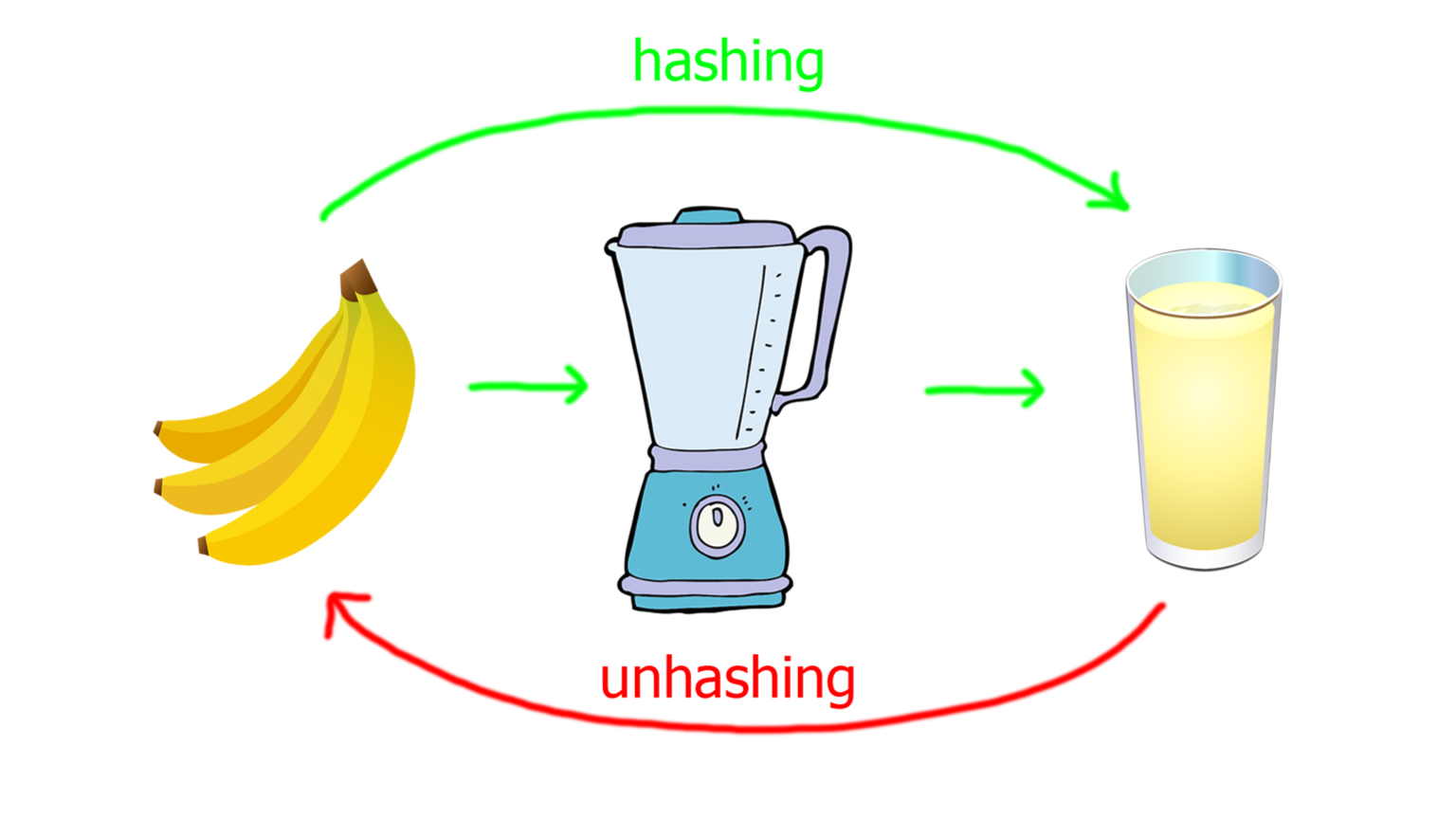
As you can see, you cannot make a banana back from the juice, so unhashing is impossible.
Hashes establish identity between inputs because they are unique. We can safely assume that if 2 inputs have the same hash, they are identical.
We can also use hashes for data encryption. We can find the hash of a some data in a lot of ways. Some of them are:
Getting the hash (md5 in this case) of a text using Bash
root@kali:~$ echo -n "Random plaintext" | md5sum
1155bd70728d5dc0e1856f7742621d94  -
We can see that by adding, changing or deleting a character from the text, radically changes the hash:
root@kali:~$ echo -n "Random plaintextt" | md5sum
43052701309339b0a084bfbe5a5e531c
root@kali:~$ echo -n "Random plaintest" | md5sum
29adfa240cda59153245464ed8de4ec1
root@kali:~$ echo -n "Random plaintex" | md5sum
d992ee83f3675b4021e0bb614021ffeb
Getting the hash (sha-1 in this case) of a text using Python:
We will use the module hashlib in order to get hashes in Python:
import hashlib

text = "some kind of text"
h = hashlib.sha1(text.encode('ascii'))

print(h.hexdigest())
This code would provide the following sha-1 hash:
1145d8b71c84d1b0a717d36bd0cd6638697bd606
We can store passwords as MD5, SHA-1 or SHA-2 (most popular ones), so that in case of a security breach, the real passwords are still hidden. An unsecure and naive way of storing passwords is:
|  User   |      Password      |
|:-------:|:------------------:|
| Robert  | S3cur3.p@ssw0rd?   |
| Maria   | Palmademallorca123 |
| Ciprian | password           |
A much better approach is to store the passwords hashed, as mentioned above:
|  User   |             Password             |
|:-------:|:--------------------------------:|
| Robert  | 0daeb943b4cc762da2c541c7338c90b6 |
| Maria   | 9daa2547b9a0155841d7f653257e3762 |
| Ciprian | 5f4dcc3b5aa765d61d8327deb882cf99 |